
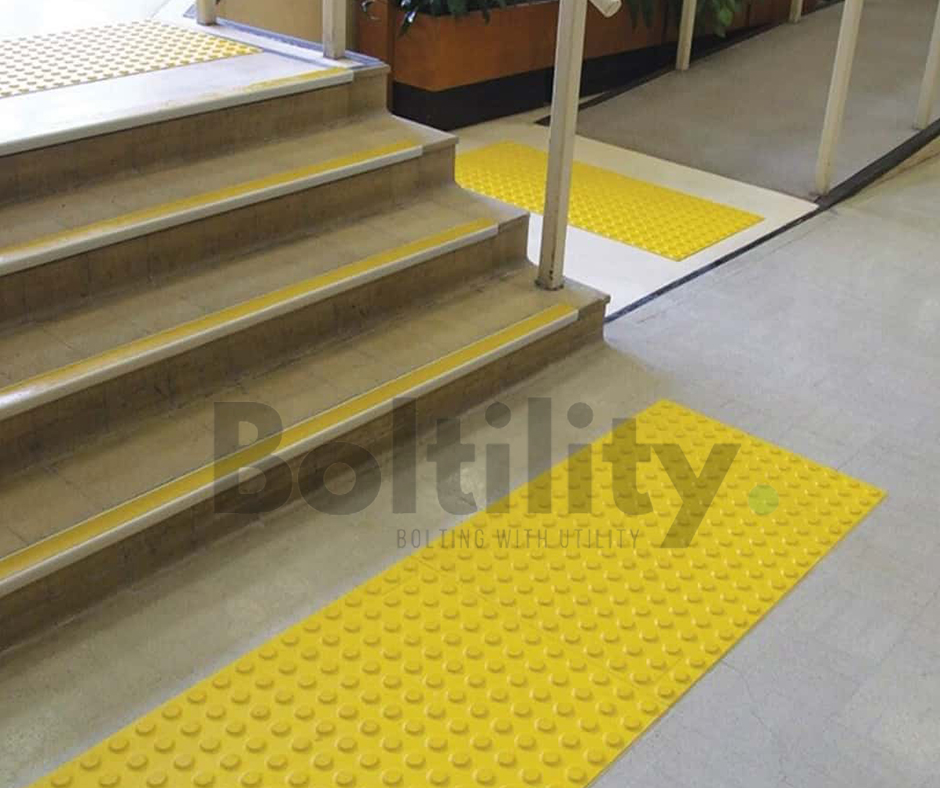
Anti Slip PVC Tactile Indicators Singapore
Anti Slip PVC Tactile indicators provide a practical solution for improving safety, accessibility and pedestrian navigation in commercial buildings, public facilities, walkways, transport areas and other high-traffic environments. Designed with raised tactile surfaces, PVC tactile indicators help provide physical cues for people who are blind or vision-impaired while also providing a visible and textured surface for safer pedestrian movement.
At Boltility, we supply Anti Slip PVC Tactile Indicators for projects that require reliable tactile guidance and warning surfaces. PVC tactile solutions are lightweight, versatile and suitable for a wide range of indoor and outdoor applications.
What is Anti Slip Stair Nosing?
Anti slip stair nosing is a safety strip installed on stair edges to improve grip, reduce slips and falls, and highlight step boundaries. It enhances accessibility in public and private buildings while protecting stair surfaces from wear.
Key Benefits of Anti Slip Stair Nosing:
- Provides superior slip resistance on stairways and landings
- Improves visibility of each step for safer movement
- Protects stair edges from damage and heavy foot traffic
- Easy to maintain and clean for long-term use
- Ensures compliance with building safety standards
What Is Anti Slip PVC Tactile?
Anti Slip PVC Tactile refers to tactile indicators manufactured from polyvinyl chloride (PVC) with a raised or textured surface. The tactile pattern can be detected underfoot or with a mobility cane, providing important information about the surrounding environment.
PVC tactile indicators are commonly used to identify hazards, changes in level and designated pedestrian routes. Depending on the design, tactile indicators can provide either warning information or directional guidance.
Unlike ordinary floor markings, tactile indicators provide information through touch as well as visual contrast, making them an important component of accessible environments.
Why Use Anti Slip PVC Tactile Indicators?
Choosing the right tactile indicator is important for both safety and accessibility. Anti Slip PVC Tactile Indicators offer several practical benefits:
1. Improved Pedestrian Safety
The textured surface provides additional surface definition and helps identify specific areas where pedestrians should take extra care.
2. Accessibility for People with Visual Impairments
Raised tactile patterns can be detected by a person’s feet or white cane. This allows tactile indicators to communicate information that cannot be provided by ordinary visual signs alone.
3. Warning and Directional Guidance
PVC tactile indicators can be used for different purposes depending on their pattern.
Warning tactile indicators generally use raised dots or domes to alert users to hazards or changes in level.
Directional tactile indicators generally use raised bars or lines to provide directional guidance along an accessible route.
4. Suitable for High-Traffic Areas
PVC tactile products can be used in locations where there is regular pedestrian movement, subject to selecting the appropriate product specification and installation method for the environment.
5. Easy Installation
Depending on the product and substrate, PVC tactile indicators can be installed using suitable adhesive, self-adhesive backing or mechanical fixing systems.
This makes them useful for both new construction and retrofit accessibility projects.
6. Practical and Cost-Effective
PVC is a lightweight material that can provide a practical alternative for projects where a durable and economical tactile indicator solution is required.
Types of PVC Tactile Indicators
There are two main types of tactile ground surface indicators used to provide different types of information.
PVC Warning Tactile Indicators
Warning tactile indicators are designed to alert pedestrians to a hazard, change in level or other area requiring caution.
They are commonly associated with raised dot or dome patterns.
Typical applications include:
- Staircases and stair landings
- Ramps
- Pedestrian crossings
- Platform edges
- Kerbs and changes in level
- Hazardous areas
- Building entrances and other strategic locations
The purpose is to provide an identifiable tactile warning before a person reaches a potentially hazardous location.
PVC Directional Tactile Indicators
Directional tactile indicators are designed to help guide a person along an accessible route.
They typically feature raised linear bars that provide directional information through touch.
They may be used in:
- Building entrances
- Corridors
- Public facilities
- Transport facilities
- Shopping malls
- Hospitals
- Educational institutions
- Large pedestrian areas
Correct placement is important because tactile indicators are intended to provide meaningful orientation information rather than simply being decorative floor features.
Anti Slip PVC Tactile for Singapore Buildings
Singapore places increasing emphasis on creating an accessible and inclusive built environment.
The Building and Construction Authority (BCA) Code on Accessibility in the Built Environment provides baseline accessibility requirements for buildings and covers new building works as well as additions and alterations to existing buildings. The current Code 2025 includes enhanced provisions relating to accessibility.
BCA’s accessibility guidance recognises tactile ground surface indicators (TGSIs) as an important way of providing information to people who are blind or vision-impaired. TGSIs include warning and directional indicators.
For this reason, selecting the appropriate tactile product and installing it correctly should be considered as part of the overall accessibility design of a building.
Important: Product selection and installation should always be checked against the latest applicable Singapore requirements and the specific requirements of the project. Do not assume that every PVC tactile product automatically complies with every accessibility requirement.
Where Can Anti Slip PVC Tactile Be Used?
Anti Slip PVC Tactile Indicators can be considered for many different environments.
Commercial Buildings
Offices, shopping centres, hotels and other commercial properties can use tactile indicators to improve accessibility around entrances, circulation areas, stairs and other key locations.
Schools and Educational Facilities
Tactile indicators can support accessible routes and help identify hazards and changes in level within educational environments.
Hospitals and Healthcare Facilities
Hospitals, clinics and healthcare facilities benefit from clear accessibility features because patients and visitors may have different mobility and visual requirements.
Transport Facilities
Tactile indicators are commonly associated with transport environments where passengers need clear warning and directional information.
Public Walkways
Outdoor pedestrian routes, crossings and changes in level may require tactile warning or directional treatment depending on the design and accessibility requirements.
Residential and Mixed-Use Developments
Tactile indicators can also be incorporated into suitable residential, condominium and mixed-use developments where accessibility features are required.
Anti Slip PVC Tactile vs Other Tactile Materials
Tactile indicators are available in different materials, including PVC, stainless steel, ceramic and other specialised materials.
PVC can be attractive for projects where the priorities include:
- Lightweight installation
- Practical cost
- Flexible application
- Easy replacement
- Suitable colour options
- Indoor or selected outdoor applications
However, the best material depends on the location, expected pedestrian traffic, substrate, exposure to weather, cleaning requirements and project specifications.
For particularly demanding environments, project designers and contractors should assess the required material and fixing method rather than choosing a tactile product based on price alone.
What to Consider When Choosing Anti Slip PVC Tactile
Before purchasing PVC tactile indicators, consider the following:
Surface and Substrate
Check whether the tactile indicators will be installed on concrete, tiles, stone, vinyl or another surface. The substrate can affect the appropriate installation method.
Indoor or Outdoor Installation
Outdoor installations may be exposed to rain, sunlight, temperature changes and heavy pedestrian traffic. The product specification should therefore be suitable for the intended environment.
Tactile Pattern
Determine whether the project requires a warning tactile indicator or a directional tactile indicator.
Slip Resistance
The tactile surface should be appropriate for the conditions where it will be installed, particularly in areas where moisture may be present.
Visual Contrast
Colour and visual contrast can be important considerations in accessible design. The appropriate contrast should be assessed as part of the overall project design.
Fixing Method
Depending on the product, installation may involve adhesive, self-adhesive backing or mechanical fixing. The fixing method should provide secure attachment to the substrate.
Accessibility Requirements
Always check the latest applicable BCA requirements, project specifications and other relevant standards before installation.
Anti Slip PVC Tactile Installation
Correct installation is just as important as selecting the right product.
Before installation, the surface should be clean, dry and properly prepared. The installer should ensure that the tactile indicators are positioned accurately according to the approved drawings and accessibility requirements.
For adhesive installations, the adhesive should be compatible with both the PVC tactile product and the floor substrate.
For larger projects, contractors should also consider:
- Site conditions
- Surface preparation
- Product layout
- Alignment
- Spacing
- Adhesive compatibility
- Mechanical fixing requirements
- Cleaning and maintenance
- Weather exposure
Poor installation can reduce the effectiveness and service life of an otherwise suitable tactile product.
Benefits of Anti Slip PVC Tactile Indicators:
- Improved Navigation:
- Tactile indicators help visually impaired individuals move safely and confidently in unfamiliar spaces by providing tactile cues.
- Enhanced Safety:
- The anti-slip surface reduces the risk of accidents, even in wet or high-traffic areas.
- Durable and Cost-Effective:
- PVC tactile indicators are resistant to wear and tear, weatherproof, and affordable, making them a long-lasting and practical solution for public and private spaces.
- Easy Installation and Maintenance:
- These indicators are lightweight and easy to install on various surfaces, including concrete, tile, and wood. They require minimal maintenance, retaining their effectiveness over time.
Applications of Anti Slip Stair Nosing and PVC Tactile Indicators:
Both anti-slip stair nosing and PVC tactile indicators have a wide range of applications in various environments, including:
- Public Transportation:
- Train stations, bus stops, and airports use these products to ensure safe navigation for passengers, especially near platform edges, stairs, and ramps.
- Commercial Buildings:
- Offices, shopping malls, and schools install stair nosing and tactile indicators to enhance safety and accessibility for all visitors.
- Outdoor Walkways:
- Municipalities use tactile indicators on sidewalks, pedestrian crossings, and curbs to assist visually impaired individuals in navigating busy streets.
- Residential Spaces:
- In residential complexes, stair nosing prevents accidents on staircases, while tactile indicators improve accessibility for residents and visitors with visual impairments.
- Industrial Facilities:
- Factories and warehouses utilize these solutions to minimize accidents in hazardous areas and ensure compliance with workplace safety standards.
Compliance with Safety and Accessibility Standards:
The installation of anti-slip stair nosing and PVC tactile indicators is often required by law to meet safety and accessibility standards, such as the Americans with Disabilities Act (ADA) or other local regulations. These standards ensure that public spaces are designed to accommodate individuals of all abilities, promoting inclusivity and safety.
Choosing the Right Supplier:
Selecting high-quality anti-slip stair nosing and tactile indicators is crucial to ensuring long-lasting safety and compliance. At Boltility, we provide premium anti-slip solutions tailored to meet the needs of various industries and environments. Our products are manufactured to the highest standards, ensuring durability, functionality, and easy installation.
Conclusion:
Both anti-slip stair nosing and anti-slip PVC tactile indicators play vital roles in enhancing safety and accessibility in modern spaces. By reducing the risk of accidents and improving navigation for visually impaired individuals, these solutions contribute to creating safer and more inclusive environments.
Whether you’re managing a commercial building, public space, or residential property, investing in these safety features is a step toward a safer future for all.
For premium-quality anti-slip stair nosing and PVC tactile indicators, trust Boltility as your reliable supplier. Contact us today or visit our website at Boltility.com.sg to explore our wide range of safety products and solutions! Let us help you make your spaces safer and more accessible for everyone.
Others Products: